What to see in Thailand in a wheelchair: 7 accessible places
- Asia
- Thailand
- Beaches and islands
- Culture and art
What to see in Thailand in a wheelchair: temples, activities, beaches, cities and markets, and what you need to know before you travel.
Travelling to Thailand can seem like an unreachable challenge. But in this article we want to tell you that we have worked on the destination in depth.
Read on and discover everything this wonderful country has to offer you.
Explore Thailand: 7 accessible places for wheelchair users
Thailand is certainly an exotic destination that combines a rich cultural heritage, majestic temples and dazzling landscapes. Incidentally, this Southeast Asian country, famous for its hospitality and vibrant street life, has made significant progress in accessibility, which makes it an attractive option for travellers who use a wheelchair.
So, in this article we present seven must-see places in Thailand that are accessible and offer unforgettable experiences. If you decide to travel to Thailand in a wheelchair, don't miss these places, which will let you enjoy the country.
1. Ayutthaya: A journey into the past
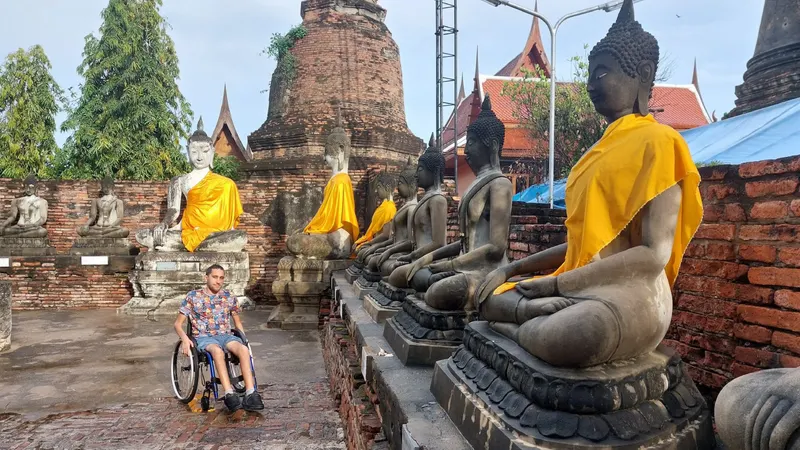
First of all, Ayutthaya, the former capital of the Kingdom of Siam and a UNESCO World Heritage Site, is a place full of history and impressive ruins.
Although some areas can be hard to reach because of the terrain, Wat Mahathat, famous for the Buddha head entwined in the roots of a tree, has paved paths that make the visit easier.
Incidentally, having a specialist guide can be a good option to get to know this historic site better.
2. The Grand Palace in Bangkok: Royal and spiritual splendour
Second, the Grand Palace in Bangkok is an architectural jewel that reflects the rich history and culture of Thailand. For those who travel in a wheelchair, the Grand Palace is accessible thanks to the ramps and walkways in most of the main areas.
Among others, the Temple of the Emerald Buddha, inside the complex, is a place you can't miss. In addition, palace staff are available to offer assistance when needed.
3. Wat Sri Suphan in Chiang Mai: Tranquillity and spirituality
On the other hand, this temple, known as the Metal Temple, Wat Sri Suphan in Chiang Mai is a temple made entirely of silver, famous for its intricate design and serene atmosphere. Also, the flat, accessible areas allow visitors in a wheelchair to explore the temple with ease.
Incidentally, the calm and spirituality you feel in this place make it an essential stop on your trip through the north of Thailand.
4. Wat Rong Suea Ten in Chiang Rai: A visual spectacle
Fourth, the Blue Temple, or Wat Rong Suea Ten, is a modern wonder in Chiang Rai. Its vibrant colours and innovative design have also made it a popular destination. Fortunately, the temple is accessible for people with reduced mobility, with ramps and smooth paths that make exploring easier.
For all these reasons, this place offers a unique visual experience, perfect for capturing unforgettable memories.
5. The Big Buddha in Phuket: An imposing icon
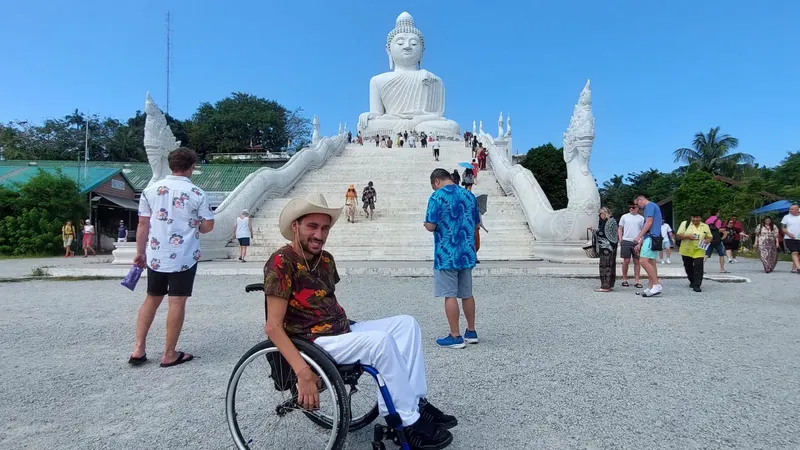
On the other hand, at the top of a hill in Phuket stands the Big Buddha, a colossal 45-metre statue that dominates the landscape. In addition, the panoramic views from the viewing area are spectacular and, best of all, are accessible for wheelchair users thanks to ramps and wide paths.
So, this symbol of peace and hope is an essential stop on your trip to Thailand.
6. Wat Traimit in Bangkok: History and devotion
Sixth, the Temple of the Golden Buddha, or Wat Traimit, houses the largest statue of Buddha in the world made of solid gold. Conveniently located in the heart of Bangkok, this temple has lifts and ramps that let you admire this work of art.
Because of all this, the fascinating history behind the statue makes the visit even more rewarding.
7. Wat Rong Khun in Chiang Rai: Art and spirituality combined
Finally, known as the White Temple, Wat Rong Khun is an artistic masterpiece that combines spirituality with a cutting-edge design. In addition, although some areas can present challenges because of their artistic design, the main entrance and the surrounding areas are accessible for wheelchair users.
Finally, this place, one of the most photogenic in Thailand, is a must-see for anyone who travels.
Thailand was one of the trips I'd always had in mind and I came back absolutely delighted, I was amazed. Thank you so much for organising everything so well ( I know I gave you more than one headache getting it all ready, as I understand it's a harder destination, but anyway, everything turned out brilliantly) and well, as I said, thank you so much for everything!Read more testimonials from our travellers on our website
Services and accessibility in Thailand
Accessibility in Thailand:
On the one hand, Thailand has made important progress in the accessibility of its main tourist destinations. That is how many attractions are equipped with ramps, paved paths and trained staff to assist visitors with reduced mobility.
On the other hand, this can make travelling to Thailand in a wheelchair a more comfortable experience.
Research and testing by Travel Xperience:
Incidentally, at Travel Xperience we have researched and tested this destination in depth, identifying accessible itineraries, accommodation, transport and activities. Above all, our aim is for you to enjoy your trip to Thailand in a wheelchair and explore everything this beautiful country has to offer.
Recommendations:
Lastly, to make the most of your trip, we recommend planning ahead, booking accessible accommodation and using accessible transport services. These preparations will let you enjoy the adventure fully, without setbacks.
Practical tips for travelling to Thailand
Climate and best time to visit:
Thailand has a tropical climate, with a rainy season that runs from May to October. For this reason, the best time to visit the accessible places is between November and February, when the weather is cooler and drier.
Accessible transport and accommodation:
As for these services, Thailand offers some accessible transport and accommodation options for people with reduced mobility. From wheelchair-accessible taxis to hotels with accessible rooms, it is possible to get around and stay comfortably across the country.
That said, you need to research thoroughly, check the information and make sure that each of these services meets the accessibility requirements you need.
Additional tips:
As always, it is advisable to take a suitable wheelchair or other mobility equipment, bearing in mind the possible irregularities of some terrain during your trip and, of course, to prepare a flexible itinerary that lets you change it whatever the circumstances.
Lastly, consider hiring guides who specialise in accessibility to make your travel experience easier.
Conclusion
To finish, we want to tell you that Thailand is a country that impresses not only for its cultural and scenic richness, but also for its commitment to accessibility.
In addition, thanks to the research and testing work we have carried out at Travel Xperience, it is now possible to enjoy a trip to Thailand in a wheelchair, exploring its temples, palaces and natural wonders alongside guides specialising in accessible tourism whom we have trained.
For all this, don't let limitations stop you; the magic of Thailand is within everyone's reach.
Get ready for an unforgettable adventure!
Frequently asked questions
Is Thailand an accessible destination for people in a wheelchair?
We can confirm that Thailand has made significant progress in accessibility in recent years. Many of its main tourist attractions, such as temples, palaces and monuments, have ramps, paved paths and trained staff to help visitors in a wheelchair.
However, it is important to plan the trip in advance and choose accessible accommodation and transport, as well as check the accessibility details of the places of tourist interest.
What is public transport in Thailand like for people with reduced mobility?
Incidentally, public transport in Thailand, especially in big cities such as Bangkok, has improved in terms of accessibility. Namely, some metro and train stations have lifts and ramps. However, not all public transport is adapted.
Even so, outside these big cities accessible public transport is not yet in place. For this reason, we recommend using wheelchair-accessible taxi services or booking private accessible transport to get around more comfortably.
What kind of accommodation is accessible in Thailand?
On the one hand, in Thailand some accommodation run by international chains and some boutique hotels offer accessible rooms for people with disabilities. These places usually have accessible bathrooms, level-access showers and beds at a suitable height.
On the other hand, it is advisable to confirm the specific features of the room when you make the booking.
Is it easy to find accessible toilets in Thailand?
Certainly, at the main tourist attractions, shopping centres and hotels in Thailand, accessible toilets are common. However, in rural or less developed areas it can be harder.
In any case, it is advisable to plan your stops in advance and, if possible, have a contingency plan, such as locating accessible cafés or restaurants in the area.
What are the best times to travel to Thailand, considering the weather?
The best time to visit Thailand is between November and February, when the weather is cooler and drier. This is especially important for travellers in a wheelchair, since during the wet season (May to October) heavy rain can make it harder to reach certain places and make paths slippery and difficult to get along.
Is there any support available at Thai airports for people with disabilities?
Yes, Thailand's international airports, such as Suvarnabhumi Airport in Bangkok and Phuket International Airport, offer assistance services for passengers with disabilities.
In general, these services include wheelchairs, help with boarding and disembarking, and trained staff to help throughout the whole process at the airport.
In any case, be sure to tell the airline and the airport in advance to make sure the assistance is arranged.
Can I hire medical or mobility equipment in Thailand?
In Thailand's main tourist cities, such as Bangkok, Chiang Mai and Phuket, it is possible to hire medical and mobility equipment, including wheelchairs, mobility scooters and other assistive devices. Of course, it is advisable to contact a hire company in advance to check the availability and conditions of the equipment.
What is accessibility like on Thailand's beaches?
On the one hand, some popular beaches in Thailand, especially in Phuket and Krabi, have improved their accessibility, offering ramps that reach the sand, walkways and support services for people with reduced mobility; at some of them you can even request an amphibious wheelchair to enjoy the sea.
However, not all beaches are adapted, so it is advisable to research beforehand and choose the beaches that best suit your needs.
Is it safe for a person with a disability to travel alone to Thailand?
In general, Thailand is a safe country to travel to, also for people with disabilities. However, people with reduced mobility who travel alone are advised to take extra precautions, such as planning the itinerary in detail, hiring specialist guides and making sure they have access to medical services in case of emergency.
For this reason, travelling with a companion or in a group can also be a safer and more comfortable option.
What services does Travel Xperience offer to people with disabilities who want to travel to Thailand?
Travel Xperience offers a personalised travel experience in Thailand, thanks to our work surveying and testing the destination.
We have local partners who know the needs of travellers with reduced mobility in depth, which allows us to offer accessible transport across the country, from vehicles with ramps to wheelchair-accessible taxis.
We also carefully select accessible accommodation, with photos of the room and the bathroom that we send you so you can see what you need. We can also arrange accessible activities and guided tours during your trip to Thailand.
In addition, all our travellers have a 24-hour phone line to deal with any incident that might arise during the trip. Travelling with Travel Xperience means you will have a perfectly organised experience, knowing that all your needs will be met.
Published on .