What to see in China in a wheelchair: transport, accommodation and cities
- Asia
- China
- Culture and art
What to see in China in a wheelchair: find out what transport, accessible accommodation and the main cities of the trip are like.
Accessible China: a guide to travelling in a wheelchair, with transport, accommodation and cities
China is a fascinating destination where futuristic cities, ancient monuments and age-old traditions come together in a single trip. However, if you use a wheelchair or have reduced mobility, you are probably wondering how far it is possible to travel around the country comfortably.
Although barriers still exist, discovering an accessible China is becoming more and more possible. The key is to plan your itinerary well and, above all, to know what you can expect at each destination. Good planning with an expert from Travel Xperience can make a big difference when it comes to enjoying China in a wheelchair.
In this guide we will explore Beijing, Shanghai and Xi’an, look at how to get around and where to stay, and discover some of their most emblematic places from an accessibility point of view.

Is China an accessible destination?
Accessibility in China varies considerably depending on the city and the place you visit.
The big cities have improved their infrastructure, and you will find more and more lifts, ramps, accessible toilets and assistance services. In addition, the Beijing 2008 Paralympic Games gave a significant boost to improving accessibility in the capital.
However, in historic buildings, traditional neighbourhoods and rural areas you may still come across steps, changes in level or uneven paving.
So when we talk about an accessible China, we do not mean a destination completely free of barriers. Rather, we mean a country that offers more and more possibilities for travelling with reduced mobility if you know the access points and alternatives available in advance.
Accessible transport in China
Getting between China's main cities is easier than you might imagine. Modern airports, a huge high-speed rail network and metro systems make it possible to organise much of your journey by public transport.
Airports and assistance
The major airports in Beijing, Shanghai and Xi’an have services for travellers with reduced mobility.
These include assistance during boarding and disembarkation, courtesy wheelchairs, lifts and accessible toilets. You can also request help getting around inside the large terminals.
If you need assistance, always request it from your airline in advance.
High-speed trains
The train is one of the best ways to get around China.
The extensive high-speed network connects cities such as Beijing, Shanghai and Xi’an quickly and comfortably. The large stations also have lifts, accessible toilets and waiting areas for passengers who need assistance.
Stations such as Beijing South, Shanghai Hongqiao or Xi’an North have accessible routes and staff who can help you during boarding.
That is why the train can become one of your great allies on the trip.
But watch out! On the downside, we must tell you that, so far, high-speed trains in China do not allow electric handbikes, so if you use this mobility equipment, the only way to travel between cities is by plane.
Metro and urban transport
Metro accessibility varies depending on the city, the line and the age of each station.
In Beijing and Shanghai you will find many stations with lifts and accessible entrances. However, do not assume that every station or every exit offers the same level of accessibility.
For that reason, before making a journey it is worth checking which exit has a lift.
Travel Xperience tipBefore your trip, download a translator that works offline and save important addresses written in Chinese on your phone. Being able to show the name of a station, a hotel or an attraction directly can make getting around much easier.
Accessible accommodation in China
Finding accessible accommodation in China is becoming easier all the time.
Above all, the big cities have modern hotels with accessible rooms, lifts and step-free access. Higher-category establishments and international chains also tend to offer more options for travellers with reduced mobility.
However, never assume that two rooms described as “accessible” offer the same features.
Before booking, check what you really need. For example, ask about the type of shower, whether there are grab rails and where they are positioned, the turning space, the width of the doors or the height of the bed.
Travel Xperience tipAsk for real photographs of the room and, especially, the bathroom before confirming your booking. A picture can quickly clarify things that terms such as “accessible” or “adapted” do not always let you verify.

The main cities for discovering an accessible China
Once the practical matters are sorted, it is time to discover the country.
Beijing, Shanghai and Xi’an show three completely different faces of China. They also let you combine some of its greatest historical and cultural attractions with different levels of accessibility.
Accessible Beijing: ancient history
Beijing is often one of the main gateways to the country.
As well as being the capital, it is home to some of China's most emblematic monuments. Fortunately, it has also made significant progress on accessibility.
However, this is a city with thousands of years of history. For that reason, some monuments still have barriers linked to the preservation of their original architecture.
Tiananmen Square
The vast Tiananmen Square has large paved areas, so getting around in a wheelchair is relatively easy.
That said, the distances are huge. So it is worth working out how much time and energy you will need for the visit.
The Forbidden City
The Forbidden City is one of those essential visits on any trip to Beijing.
Its historic buildings have numerous changes in level and thresholds. However, there are accessible routes and ramps that let you see a good part of the complex.
Even so, certain areas and buildings have limitations. In addition, some paving is uneven, so getting around this enormous palace may take extra effort if you use a manual wheelchair.
The Temple of Heaven
The Temple of Heaven is another of Beijing's great symbols.
A good part of its gardens can be explored comfortably, and there are adaptations at different points in the complex.
What is more, here you will find more than imperial architecture. In its gardens you can watch many scenes of everyday life in Beijing.
The Great Wall of China in a wheelchair: Badaling or Mutianyu
We come to one of the big questions of the trip: can you visit the Great Wall of China in a wheelchair?
Yes, although it is important to understand that this is a structure built over mountains and steep slopes. So it is not possible to walk long stretches of it in the same way as someone without mobility difficulties.
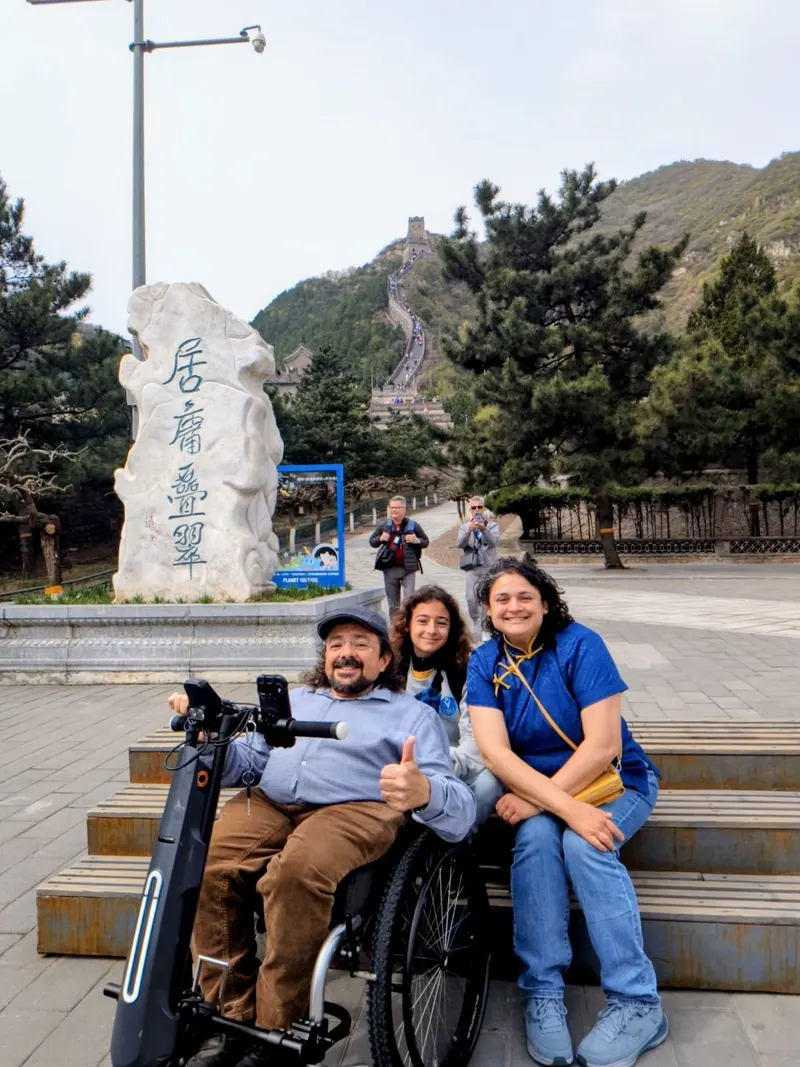
However, Badaling and Mutianyu offer ways to get close to the Great Wall in a wheelchair, although each has its advantages and drawbacks.
Badaling: the most accessible option
If accessibility is your priority, Badaling is usually the easiest option.
It is the section with the most developed accessible infrastructure, with ramps and lift systems that let you reach one part of the Wall.
Its main advantages include ease of access, more tourist infrastructure and its proximity to Beijing.
However, there is one important drawback: it is also one of the most visited sections. For that reason, crowds can make it hard to get around, especially in high season.
Mutianyu: quieter, but also more demanding
Mutianyu offers a different experience.
This section is surrounded by mountains and is usually quieter than Badaling. It also has a cable car, which takes care of much of the climb needed to approach the Wall.
However, having a cable car does not mean the route is fully accessible. There are slopes and uneven surfaces, so some wheelchair users may need assistance.
Its main advantage is the setting. If you are looking for spectacular views and a quieter experience, Mutianyu can be a great alternative.
On the other hand, if your priority is the greatest possible accessibility, Badaling is usually the most comfortable option.
Travel Xperience tipDo not choose your section of the Great Wall based only on photographs. Consider the type of wheelchair you use, how well you can cope with slopes and the help you will have during the visit. Also, try to go early to avoid the worst of the crowds.
Summer Palace
After several days exploring Beijing, the Summer Palace offers a pleasant change of pace.
Its gardens, pavilions and views of Kunming Lake let you discover another side of former imperial life. There are also accessible routes in some of its main areas.
As in other historic monuments, not the whole complex is free of barriers. Even so, it is well worth including in your itinerary.
Accessible Shanghai: tradition and future
If Beijing represents much of imperial history, Shanghai shows the most futuristic face of China.
Skyscrapers, vast avenues and modern transport systems paint a completely different city. Its infrastructure also makes accessible Shanghai one of the most comfortable destinations on this itinerary for wheelchair users.
The Bund
The Bund is one of those places you will probably want to visit more than once.
This great promenade beside the Huangpu River offers one of Shanghai's most famous views. In front of you rise the skyscrapers of Pudong, while behind you stand the elegant historic buildings of European influence.
The promenade also has wide areas that make getting around easy.
Travel Xperience tipTry to visit the Bund at dusk as well. The lighting of Pudong completely transforms the landscape and offers one of Shanghai's most spectacular views.
Shanghai Museum
If you want to understand the country's history and art better, the Shanghai Museum is a very interesting visit.
Its facilities have lifts, ramps and accessible toilets, so you can explore its collections comfortably.
A museum visit can also be a good way to balance busier days with quieter activities.
Shanghai Tower and the Oriental Pearl Tower
Shanghai is also something to enjoy from above.
Shanghai Tower has lifts that take you up to its famous observation deck. The Oriental Pearl Tower also offers several accessible spaces.
From their viewing platforms you will get a much better sense of the gigantic scale of this metropolis.
The Old City of Shanghai
However, Shanghai is not just skyscrapers.
The Old City preserves a network of streets with traditional architecture, wooden houses, curved roofs and many details in shades of red. Walking through this area is like stepping into a completely different setting.
In some places you will find uneven paving and very crowded streets. So it is best to explore without rushing.
It is precisely this contrast between traditional China and the futuristic city that makes the area one of Shanghai's most interesting experiences.
Accessible Xi’an: in the footsteps of imperial China
For centuries, Xi’an was one of the most important cities in the world.
As well as serving as the capital of several dynasties, it was one of the great starting points of the Silk Road.
Today, its extraordinary heritage makes the city an essential stop. However, accessible Xi’an presents some bigger challenges than Beijing or Shanghai, especially in the historic areas.
Terracotta Warriors
The Terracotta Warriors are one of China's great archaeological treasures.
The complex has accessible routes, lifts and walkways that make it easier to get around its different pavilions.
The walkways also let you look out over the huge excavations and the thousands of figures that make up this impressive army.
Xi’an City Wall
The wall surrounding the old town is another of the city's great symbols.
However, if you use a wheelchair there is one especially important fact: Hanguangmen is the gate with a lift up to the top of the wall.
Once up there, you can enjoy a broad walkway and see Xi’an from a completely different perspective.
Travel Xperience tipIf you want to go up the Xi’an City Wall in a wheelchair, save the name Hanguangmen on your phone beforehand. That way you can head straight to the entrance with the lift and avoid unnecessary detours.
Muslim Quarter
After visiting the great monuments, it is time to immerse yourself in one of the areas with the most character in Xi’an.
The Muslim Quarter is a maze of streets full of food stalls, small shops and the aromas of spices.
However, it can also get extremely crowded. So, if you use a wheelchair, try to avoid the busiest hours. That way you can get around more comfortably and enjoy the atmosphere much more.
Chinese cuisine: the journey continues at the table
Simply talking about “Chinese food” falls far short.
China has enormous culinary diversity, and each region has its own recipes, ingredients and flavours. So travelling between Beijing, Shanghai and Xi’an is also a small culinary journey.
What to eat in Beijing
The star of the show is, of course, Peking duck.
Its characteristic crispy skin is traditionally served with thin pancakes, vegetables and sauce.
Northern cooking also makes frequent use of wheat, dough and noodles. So you will find flavours and dishes quite different from those you probably associate with the Chinese food we know in Spain.
What to eat in Shanghai
Shanghai cuisine is characterised by mild flavours and, in some dishes, a slight sweetness.
One of its most famous specialities is xiaolongbao, small dumplings filled with meat or crab and broth.
Precisely because of the broth inside, eating them for the first time takes some technique: bite carefully and let some of the steam out before tasting them.
Fish and seafood also have a strong presence in local cuisine.
What to eat in Xi’an
In Xi’an the cuisine changes again.
The history of the Silk Road and the city's large Muslim community have left a deep culinary mark.
Here you will find dishes made with noodles, breads and lamb. Among the best known are biang biang noodles, distinctive wide hand-made noodles.
In the Muslim Quarter you can also find spiced lamb skewers and many local specialities.
An important point about toilets
There is a practical matter worth knowing about before you sit down to eat.
In China, not all restaurants have a toilet for customers, especially some small or traditional places.
So, if you need an accessible toilet, it is better not to wait until you reach the restaurant. Make use of the accessible public toilets you find along the way, and then you can sit down and enjoy your meal in peace.
Travel Xperience tipAlways carry tissues or toilet paper and hand sanitiser. Also, when you find an accessible public toilet in good condition, take the opportunity even if you do not yet need to use it.
I have trusted Travel Xperience on several occasions and my rating is 11 out of 10. They are extremely resourceful people who understand perfectly the needs of travellers who use a wheelchair or have reduced mobility. What I value most is that before anything else they carry out a thorough study of what we need and then present fully tailor-made proposals, allowing any change until the trip is perfect.
They really work ‘behind the scenes’ so that all we have to do is enjoy ourselves. Without a doubt, an agency you can trust completely to travel without barriers.Guillem and family – China 2026Read more testimonials from our travellers on our website
Final tips for travelling around China in a wheelchair
Throughout the article we have shared recommendations specific to each place. However, there are still some general tips that can help you throughout the trip.
Do not try to see everything
Distances in China are huge. In addition, some monuments cover much larger areas than they seem to on a map.
So avoid filling every day with too many visits. Leaving time between activities will let you deal with any unexpected problems and, above all, enjoy the trip without turning it into a race.
Always carry a power bank
Your mobile phone will be one of your great allies.
You will use it to check maps, translate, show addresses and sort out many everyday situations. So always carry a power bank so that you do not run out of battery halfway through a day.
Save important information offline
As well as hotel addresses, save screenshots of bookings, tickets and places you want to visit.
It can also be useful to have some of your mobility needs written down in Chinese. That way you can show them directly when language becomes a barrier.
Internet, VPN and mobile payments
Before travelling to China it is worth preparing your internet connection and digital payments too.
VPN and internet connection
In China some international services and apps are restricted. So, if you are going to use a VPN, install and set it up before you travel.
Another very practical option is an eSIM or international data card that connects through foreign networks, which in some cases lets you access these services without a separate VPN. Always check the provider's terms before your trip.
Apps for paying
Mobile payments are very widespread in China. So it is a good idea to set up apps such as Alipay or WeChat Pay in advance and, where possible, link an international bank card.
Also carry an alternative way to pay in case you have a problem with the app, the card or the connection.
Travel Xperience tip
Set up the VPN, the eSIM and the payment apps before arriving in China. That way you will avoid having to sort out connection or configuration problems during the trip.
If you use a powered wheelchair, prepare your flights carefully
Before flying, check the airline's conditions for carrying your wheelchair.
Note down the model, weight, dimensions and battery details. Taking photographs of the wheelchair before handing it over can also be useful for recording its condition. The reference guide also recommends telling the airline about the characteristics of your mobility equipment beforehand.
Travel Xperience tipLeave some room for improvisation. A lift may be at a different exit, you may have to look for an alternative entrance or you may need help at some point. If you plan days with enough time, these small hiccups will be much easier to deal with.
Help at your destination
At Travel Xperience, we design tailor-made trips, especially in destinations such as China, for people with disabilities or reduced mobility.
Our services are fully personalised to suit your needs, and our team is available for emergencies 24 hours a day to give you the support you need at every step of your trip.
Get in touch with us and let us help you plan a trip designed for you.
Accessible China: a destination worth discovering
China is not a destination completely free of barriers, but nor is it the impossible destination for wheelchair users that many people imagine.
Beijing lets you get close to places as extraordinary as the Forbidden City or the Great Wall. Shanghai combines modern infrastructure with corners that preserve the essence of traditional China. And Xi’an lets you discover the Terracotta Warriors and visit some of the most important settings of the ancient Silk Road.
So the difference lies in planning.
Knowing the right access points in advance, organising your transport and choosing your accommodation carefully will let you enjoy a much more comfortable experience.
Because travelling accessibly does not mean giving up on getting to know the essence of China. It means designing the trip around your needs so that barriers are not the stars of the experience.
At Travel Xperience we do not just create itineraries: we design personalised experiences so that your trip to China for people with reduced mobility is comfortable, safe and at your own pace.
Our team takes care of transport, tickets, assistance and accommodation for your trip to China in a wheelchair.
All set to explore accessible China with complete peace of mind?
Frequently asked questions about travelling to China in a wheelchair
Is China an accessible destination for wheelchair users?
Yes, it is possible to travel to China as a wheelchair user, although accessibility varies depending on the destination. Beijing, Shanghai and Xi’an have accessible infrastructure and attractions, while in historic or rural areas there may be more barriers.
Which cities in China are the most accessible for travelling in a wheelchair?
Beijing and Shanghai offer some of the best accessible infrastructure in the country. Xi’an also lets you visit its main attractions, although some access points need more careful planning.
Can you visit the Great Wall of China in a wheelchair?
Yes. Badaling is the most comfortable option because it has the most developed accessible infrastructure. Mutianyu can also be visited using the cable car, although it has slopes and uneven surfaces that may require assistance.
Is the Forbidden City in Beijing accessible in a wheelchair?
A good part of the main route has accessible routes and ramps. However, some historic buildings and areas still have steps, thresholds and uneven paving.
Are the Terracotta Warriors accessible?
Yes. The Terracotta Warriors complex has accessible routes, lifts and walkways that let you see the main excavations.
Can you go up the Xi’an City Wall in a wheelchair?
Yes. To do so, head for Hanguangmen, the gate with a lift up to the top of the wall.
Can I travel by train in China if I use a wheelchair?
Yes. The high-speed network connects the main cities, and many of its large stations have lifts, accessible toilets and assistance services for passengers with reduced mobility.
Is there accessible accommodation in China?
Yes, especially in the big cities. However, it is best to confirm the features of the room and bathroom directly and, whenever possible, ask for photographs before booking.
Is it easy to find accessible toilets in China?
In the main cities and tourist areas there are accessible public toilets. It is a good idea to use them during your visits, since some small or traditional restaurants do not have a toilet for customers.
Do I need a VPN to travel to China?
It can be useful because some international services and apps are restricted. If you decide to use a VPN, it is best to install and set it up before the trip. Some international eSIMs also let you connect through foreign networks.
How can I pay during a trip around China?
Mobile payments are very widespread. It is worth setting up apps such as Alipay or WeChat Pay before the trip and checking the options for linking an international bank card. It is also a good idea to have an alternative way to pay.
What should I bear in mind if I travel to China with a powered wheelchair?
Before flying, confirm the airline's requirements and note down the model, weight, dimensions and battery details of your wheelchair. It is also a good idea to photograph it before handing it over for transport.
What mistakes should I avoid when organising an accessible trip around China?
Avoid planning too many visits in a single day, assuming that every access point is accessible, or booking accommodation without checking its real features. Also leave room for possible changes of access point or journeys that take longer than expected.
What support does Travel Xperience offer for organising an accessible trip to China?
At Travel Xperience we design personalised trips that take your mobility needs into account, selecting transport, accommodation and experiences so that you can discover China with greater comfort and peace of mind.We work with local partners and guides who will make your trip to China an unforgettable experience!
«`
Published on .