Complete guide to travelling to Stockholm in a wheelchair
- Europe
- Sweden
- Culture and art
Guide to travelling to Stockholm in a wheelchair: the metro with lifts, accommodation, accessible sights and tips for planning your trip.
Stockholm, the capital of Sweden, is one of the European cities best prepared for accessible tourism. With adapted streets, accessible public transport and an inclusive mindset, it offers a comfortable experience for people with reduced mobility.
For more than 20 years, the government has introduced improvements to make getting around the city easier. So if you decide to travel to Stockholm in a wheelchair, you will find pavements with ramps, lifts in metro stations and adapted museums with wide entrances.
In this guide, you will find key information for planning a trip to Stockholm if you have reduced mobility, including transport options, accessible accommodation and attractions. If you are looking for a well-connected destination with plenty of facilities, Stockholm is an excellent choice. Let's get started!
What can you find in Stockholm?
Accessible transport in Stockholm
Getting around Stockholm in a wheelchair is easy thanks to its accessible transport system. For years, the city has worked so that people with reduced mobility can travel by metro, bus, ferry and wheelchair-accessible taxi.
Stockholm is, in all likelihood, one of the most accessible cities in Europe. Here is some information that will come in useful.
Metro and trains
The Stockholm metro is one of the most accessible in Europe. All the main stations have lifts and platforms level with the carriages.
On commuter trains, some stations require the use of ramps, but these can easily be requested. In addition, audio and visual announcements make the journey easier for passengers with specific needs.
Buses and trams
All buses in Stockholm are equipped with automatic ramps and spaces reserved for wheelchairs. They have digital screens and voice announcements for every stop. The trams are also adapted, with level-access boarding, which means you can travel without difficulty.
Accessible ferries
Because Stockholm is built on islands, it has a ferry system that connects different parts of the city. Several routes, such as the Djurgården Ferry line, are accessible and have trained staff to assist passengers who need it.
Wheelchair-accessible taxis
For extra comfort, you can book wheelchair-accessible taxis with ramps or lifts for wheelchairs. It is advisable to book in advance, especially at peak times.
Arlanda Airport
Stockholm's main airport welcomes passengers with reduced mobility. It offers free assistance, accessible counters and lifts in all its terminals. It is advisable to request assistance at least 48 hours before your flight.
With all these options, travelling to Stockholm in a wheelchair lets you explore the city.
Accessible accommodation in Stockholm
Stockholm offers plenty of accessible accommodation for people with reduced mobility. Thanks to its strict accessibility regulations, many hotels, apartments and tourist accommodation are designed for a comfortable stay.
Recommended areas to stay
When choosing where to stay, it is advisable to pick central neighbourhoods that are well connected to accessible public transport: Norrmalm: the most central area, with direct access to adapted metro stations and streets with smooth surfaces. Ideal if you want comfort and proximity to the main tourist sights.
Södermalm: although some parts have slopes, there are accessible accommodation options near metro stations with lifts and flat shopping areas.
Kungsholmen: a quiet area with accessible hotels, parks with adapted routes and bus and metro connections.
Features of accessible accommodation
Adapted hotels and apartments in Stockholm usually have: Step-free entrances or ramps and automatic doors.
Spacious rooms to make it easier to move around in a wheelchair.
Accessible bathrooms, with level-access showers, grab rails and accessible washbasins.
Roomy lifts, with low-height buttons and tactile signage.
Accessible communal areas, such as dining rooms, meeting rooms and terraces.
Tips for choosing and booking accessible accommodation
Book in advance, as accessible rooms are usually limited.
Confirm accessibility directly with the accommodation, as some booking sites do not give the details clearly.
Check the location and make sure there is accessible public transport nearby. Thanks to these facilities, accessible tourism in Stockholm offers comfortable, adapted accommodation options.
Accessible public toilets in Stockholm
Although Stockholm has a good network of public toilets, not all of them are adapted for people with reduced mobility. That is why it is advisable to know in advance where to find them, to avoid any inconvenience during your trip.
Where to find them
Accessible toilets are available in train and metro stations, shopping centres, museums, parks and some public squares. In places such as Sergels Torg, Kungsträdgården and Djurgården, you will find accessible toilets with step-free access and enough space to manoeuvre.
If you need to use the toilet in a restaurant or café, bear in mind that in some older venues accessibility may be limited. So it is always a good idea to ask before going in or to check reviews on Google Maps.
Cards and access systems
Some public toilets in Stockholm require payment, although people with disabilities can use them free of charge. In train stations and shopping centres, you can ask for assistance if you need help getting into the toilets.
If you want to be sure of finding an accessible toilet near you, you can use apps such as Toalettguiden (available for iOS and Android), which shows the accessible toilets in the city.
Accessible food and drink
Food in Stockholm is a mix of tradition and modernity. It ranges from classic Swedish dishes such as cured salmon or the famous köttbullar (Swedish meatballs) to international options and cafés with a cosy atmosphere.
Restaurants and accessibility
Many restaurants in the city have been adapted to make access easier. However, in the old town and in some historic neighbourhoods, there are still venues with steps at the entrance or limited space. So before choosing a restaurant, I recommend checking Google Maps or platforms such as TripAdvisor to see whether they mention accessibility details.
As for the food on offer, Stockholm has options for every taste and dietary need. There is a wide variety of restaurants with vegetarian, vegan and gluten-free options. The Swedes also have a fika culture, a moment of the day to enjoy a coffee with a typical sweet treat such as a kanelbulle (cinnamon bun).
Tips for enjoying food in Stockholm
- If you plan to visit a popular restaurant, book in advance and check whether it is accessible.
- In some smaller venues, however, the toilets may be in basements without a lift, so it is better to confirm beforehand.
- Make the most of local food at markets such as Östermalms Saluhall (opens in a new tab), where you can find stalls with easy access and room to move around comfortably.

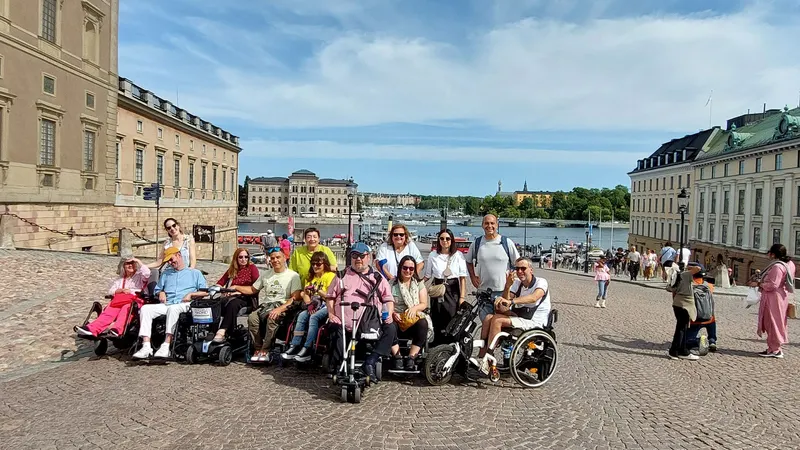
The trip to Stockholm organised by Travel Xperience was a total success. Starting with the advice on taking the batteries on the plane: we were lucky the agency had explained it to us, since even the captain came in person to find out about the wheelchair batteries.
The hotel was very well adapted and the excursions they had prepared for us were also very good to do in a wheelchair.
And the city is ideal for being a tourist in a wheelchair, it is very well adapted, the only small drawback is the cobblestones in the old town, which shake the chair a bit more, but it can be done. We will definitely take more trips with Travel Xperience! Read more testimonials from our travellers on our website
Main accessible attractions in Stockholm
If you decide to travel to Stockholm in a wheelchair, you will be glad to know that most of its main attractions have been adapted. Museums, palaces, parks and historic neighbourhoods are ready to welcome you with comfortable access, lifts, accessible toilets and assistance if you need it.
In this section, you will discover everything you can visit in the Swedish capital and how to get around each of these places with ease.
Vasa Museum
One of the most impressive museums in Stockholm awaits you with an incredibly well-preserved seventeenth-century ship. The Vasa sank on her maiden voyage and lay on the seabed for more than 300 years, until she was recovered and restored. Today, you can see her in full inside a building designed exclusively to display this historic marvel.
If you use a wheelchair, you will be able to get around the museum. The entrance is accessible, with ramps and automatic doors. Inside, you will find lifts that let you reach the different levels from which the ship can be admired.
The corridors are wide and there are accessible toilets on site. In addition, if you travel with a companion, they can enter free of charge.
ABBA The Museum
If you love music and ABBA, this is a place you cannot miss. In this interactive museum you can sing and dance as if you were part of the group, see their original costumes and follow the band's history through digital exhibitions.
From the entrance to each of its rooms, the museum has adapted access. The main entrance has a ramp, and inside the building there are lifts so you can get around without difficulty. They also have accessible audio guides and material in braille.
If you need a wheelchair, you can ask for one at reception. And best of all, if you travel with someone who assists you, that person enters free of charge.
Royal Palace of Stockholm
The Royal Palace is a must if you want to learn about the history of the Swedish monarchy. This imposing building, with more than 600 rooms, lets you explore lavish halls, see art collections and watch the changing of the guard, one of the most emblematic ceremonies in Stockholm.
Although it is an old palace, much of it has been adapted for people with reduced mobility. To get in, you can use a side entrance set up for wheelchairs.
Inside, there are lifts to move between floors, although some areas may have limited access because of the building's historic structure. You will also find accessible toilets and staff available to assist you if you need it.
Stockholm City Hall (Stadshuset)
Stockholm City Hall is an iconic building, not only for its impressive architecture but because the Nobel Prize banquets are held here. Inside, you can visit the Blue Hall, where the famous dinner takes place, and the Golden Hall, decorated with spectacular mosaics that tell the history of Sweden.
If you decide to visit, you will find it easy to get around, as it has been adapted with ramps and lifts. Although some areas may have limited access, the staff are trained to help you and make sure you enjoy the tour. There are also accessible toilets inside the building.
Djurgården and its green spaces
If you want a break from the pace of the city, Djurgården is the perfect place. This island, right in the centre of Stockholm, is home to museums, parks and gardens ideal for relaxing and enjoying nature. You can follow its accessible paths lined with trees, have a picnic or simply enjoy the scenery.
Getting around Djurgården in a wheelchair is very comfortable, as most of its paths are paved and well signposted. And if you want to arrive by ferry, you will have no problem, as most of the boats that go to the island are accessible. You will also find accessible toilets in various areas.
Gamla Stan and the challenge of cobbled streets
Stockholm's old town is one of the most charming places in the city. Its cobbled streets, historic buildings and small craft shops will transport you to the past. However, if you use a wheelchair, some streets can be tricky because of the uneven paving and slopes.
To enjoy Gamla Stan without difficulty, I recommend planning your route carefully. There are more accessible routes, such as Västerlånggatan, where the cobbles are smoother. You can also look at accessibility maps to avoid areas with steep slopes.
Some restaurants and cafés have set up accessible entrances, but it is a good idea to check before your visit.
Theatres, culture and accessible events
If you like theatre and music, you will find plenty of shows in Stockholm. Many theatres and concert halls have introduced adapted access, spaces reserved for wheelchairs and audio description or subtitle systems for people who are deaf or hard of hearing.
Outdoor events, such as festivals and concerts in parks, have also improved in terms of accessibility. They usually have reserved areas, accessible toilets and special services if you request them in advance.
Exploring Stockholm is a unique experience, and thanks to its accessible infrastructure, you can enjoy its attractions. Museums, palaces, parks and events are ready to welcome you with trained staff and adapted services. By planning your trip well and making the most of the resources available, you can get to know the Swedish capital.
Tips for planning your trip to Stockholm in a wheelchair
Stockholm is an accessible, well-connected city, but as with any destination, there are a few things you can consider to make your experience even more comfortable. If you plan your routes well and use the right resources, getting around the city will be simple.
Avoid areas with uneven ground and cobbles
Although most of Stockholm's streets and pavements are accessible, some areas can be more challenging if you use a wheelchair. Gamla Stan, for example, has cobbled streets that can make getting around difficult, but there are more comfortable routes such as Västerlånggatan.
Similarly, in neighbourhoods such as Södermalm there are steep slopes that can make getting around more demanding. If you want to avoid these obstacles, check an accessibility map before you set out.
Make the most of apps and digital tools
There are various tools that can make getting around Stockholm easier. Google Maps and Street View let you explore routes and see streets before you visit them, while on the website of (opens in a new tab) SL (Stockholm Lokaltrafik) you can check real-time information on public transport and station accessibility.
You can also use Tillgänglighetsdatabasen (opens in a new tab), a Swedish platform specialising in urban accessibility.
Plan your transport around the time of day
Although Stockholm's public transport is accessible, at peak times the carriages and buses can be busier, which could make getting around less comfortable. If you would rather avoid crowds, try to travel outside the busiest times, generally between 7:00 and 9:00 and 16:00 and 18:00.
Check the accessibility of restaurants and cafés
Not all restaurants and cafés in the city have been adapted, especially in historic buildings. Before choosing a place to eat, check the reviews from other travellers about accessibility on Google Maps, or ask the venue directly to make sure it has ramps and accessible toilets.
Bear in mind the season you travel in
If you visit Stockholm in winter, bear in mind that snow and ice can make getting around difficult in some areas. The main streets are usually cleared, but on side streets and in parks you may find slippery surfaces.
In summer, on the other hand, the long days and pleasant weather make it the best time to explore the city.
Ask for assistance when you need it
If you need help during your trip, you can ask for assistance in metro and train stations, or even at the airport. For public transport, the free assistance service is available by calling +46 20 120 20 22 in advance.
Check the weather before you set out
If you travel in winter, bear in mind that snow and ice can make getting around difficult in certain areas. It is advisable to bring thermal clothing and use cleared routes. In summer, the city is ideal for exploring outdoors, with pleasant temperatures and more than 18 hours of daylight a day.
Make the most of the benefits for people with disabilities
In Stockholm, many attractions offer free entry or discounts for people with reduced mobility and their companions. Always check the official websites of the places you plan to visit to find out what you can take advantage of.
Getting around Stockholm will be a simple experience if you plan your routes well and use the right resources. With digital tools, a good knowledge of the best routes and by avoiding the busiest times, you can enjoy the city.
Adapted services
At Travel Xperience we focus on designing, together with you, tailor-made travel experiences, especially in standout destinations such as Stockholm, for people with a disability or reduced mobility. We offer personalised services designed for your requirements.
In addition, our team of experts is available at any hour to give you all the support you need during your trip. Get in touch with us and let us help you organise your next adventure, designed around your needs.
Conclusion
Travelling to Stockholm in a wheelchair is easier than you might imagine. The city has removed barriers, offering accessible transport, step-free museums and accessible routes to its main sights, such as the Vasa Museum, the Royal Palace and Djurgården.
Although some areas, such as Gamla Stan, have cobbled streets, there are alternative routes so you can enjoy their charm without difficulty.
You will also find accessible restaurants and assistance at tourist attractions. With the right planning, you can get around with ease, stay in comfortable places and enjoy every corner of the city.
Let us help you make this trip a reality. Contact us and start discovering Stockholm. Your next destination is waiting for you!
Published on .