
How to get around London in a wheelchair
- Europe
- United Kingdom
- Culture and art
Tips for getting around London in a wheelchair, so that you can choose the means of transport that best suits what you need on your trip.
Getting around London in a wheelchair
We recently saw questions on social media about how to get around London in a wheelchair, so here at Travel we decided to write a post on the subject, so that you have as much information as possible and can choose your favourite way of getting around, or the one that best suits your needs.
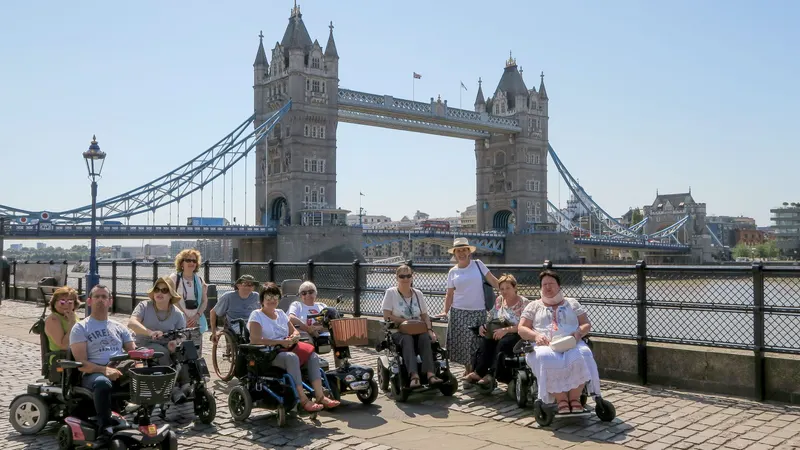
Please note that last July (2019) we had the pleasure of taking part in a group trip to the United Kingdom, during which we visited London, among other cities, so the information we are going to share is from 2019. Some routes or fares may have changed, so we'll share the general information to give you an idea.
TIPS FOR GETTING AROUND LONDON IN A WHEELCHAIR.
Before we go through each means of transport and its accessibility one by one, we'd like to give you some general facts and tips so that you have everything sorted before your trip.
The price of public transport:
You should know that, in general, transport in the United Kingdom is expensive, so we recommend that you find out about the transport options and the routes you are going to take beforehand. Planning these routes well can save you money and stop you getting lost or going round in circles.
As you will see below, the bus is free for wheelchair users, but companions do pay. On the other forms of transport wheelchair users also pay, although on some the fares are lower and it is the person accompanying who benefits from the free travel.
A tip for companions:
For companions, or on any transport where you pay a fare, we recommend getting an Oyster Card. It works like a bus pass or metro card that you top up with credit for your journeys, and the fares are lower than if you pay for each journey separately.
You have to leave a deposit of £5 for the card, which you get back when you return it. For more information, click here to go to their website. (opens in a new tab)
If you have a contactless bank card, you can tap it directly on the card readers when you board, and the fare will be taken straight from your account. The fare is the same as if you used an Oyster card. If your account is in euros, your bank may charge a small fee for the currency conversion.
For more information, click here to go to the Transport for London website (in English) (opens in a new tab). This website lets you plan your journey: specify that you need an accessible route and it will give you one, with all the information.
GETTING AROUND LONDON ON AN ACCESSIBLE BUS
In our opinion, the best way to get around London in a wheelchair is by city bus. They all have a boarding ramp and a space reserved for one wheelchair, except for the heritage buses on routes 9 and 15.
Wheelchair users also travel free, and since London is expensive anyway, we think this is the best option for getting around the city.
There are two downsides. The first is London's traffic, which is awful! Be careful about using the bus at peak times, or you could spend the rest of your holiday on it.
The second is if you are travelling with other wheelchair users: as we have mentioned, the bus only has space for 1 wheelchair, so you will either have to wait at the stops or use another form of transport that takes more than one wheelchair user.
It is also important to note that not all mobility scooters are accepted. To find out whether yours can board the bus, send an email to travelmentor@tfl.gov.uk (opens in a new tab) with its make, model, dimensions and weight, and they will confirm whether it can or not.
GETTING AROUND LONDON ON AN ACCESSIBLE TRAIN
The rail line is the DOCKLANDS LIGHT RAILWAY (DLR). All its stations are accessible by ramps and lifts, and you can travel in the carriages.
Bear in mind that there is a gap of about 7.5 cm between the carriage and the platform, and in some cases a small step of 5 cm, so some wheelchairs may need assistance.
Stations normally have portable ramps that a member of staff puts in place when needed. You just need to let them know which station you are heading to, and a member of staff will be ready to assist you.
We recommend allowing plenty of time, as staff are not always available 100% of the time, some stations have different opening hours, and so on. It's a good idea to check the information on stations and routes by clicking here. (opens in a new tab)
GETTING AROUND LONDON IN AN ACCESSIBLE TAXI
Another option if you want to get around London in a wheelchair is to use taxis. The so-called Black Cabs are all fitted with ramps and have enough space inside for you to travel in your own wheelchair. Quick, simple and door to door.
However, you should also bear in mind that they only take one wheelchair per taxi. If there are several wheelchair users in your group, you will need to consider other options or, as with the bus, take turns.
Although this is not the cheapest option, in some cases it can be the most comfortable after a “hard” day rolling around the streets of London ;-P
GETTING AROUND LONDON ON AN ACCESSIBLE FERRY
As well as getting around by land, you can travel around London in your wheelchair on one of the ferries along the Thames. As well as the sightseeing ferries, there are others that run routes like buses.
It is a good option if several of you travel in wheelchairs, as up to 4 wheelchairs are accepted. If you travel by mobility scooter, you must request permission and show the authorisation at the ticket office when you buy your ticket.
Remember to check beforehand that the piers are accessible and how far they are from where you want to go. The accessible pier for getting to central London is Westminster, and Parliament, the London Eye and Westminster Abbey (among other places) are close by, but we had to walk and roll for more than 1 hour to get to the Natural History Museum.
So, as we said before, plan your route well
GETTING AROUND LONDON ON THE ACCESSIBLE UNDERGROUND
The London Underground is the oldest metro system in the world, so, as you can imagine, accessibility is not its strong point. There is no problem at the newer stations, and Transport for London is continually making improvements so that you can get around London in a wheelchair freely, including on the Underground, but there is still work to be done.
The stations in the centre, the oldest ones, are the most problematic, as not all of them have lifts or accessible entrances. Others are accessible, but only to manual wheelchairs and with some help getting from the platform onto the train.
Here, in any case, is the route planner, so that you can find the route that suits you best, click here and you'll be taken to it. (opens in a new tab)
Finally, if you still have questions about the accessibility of any of London's transport, for any type of disability, you can click here to go to their website with all the information: (opens in a new tab)
We hope this post answers your questions about London's transport in a wheelchair and helps you plan your next getaway to this city, which is really well worth it!
Published on .