What to see in Egypt in a wheelchair
- Middle East
- Egypt
- Culture and art
- Cruises
What to see in Egypt in a wheelchair: Giza, the Grand Egyptian Museum, Abu Simbel and the Nile. And in the Valley of the Kings, the Tomb of Ramesses IV, with a ramp.
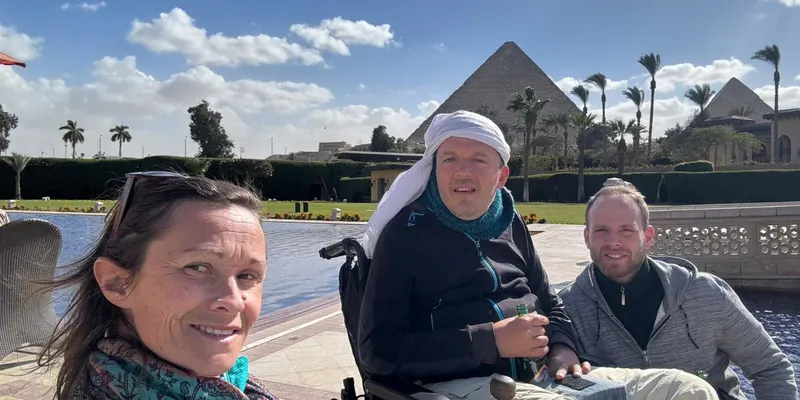
In Egypt you can visit the Giza pyramids, the Sphinx and the Grand Egyptian Museum in a wheelchair, all close to Cairo. Further south are the temples of Abu Simbel, Karnak and Luxor, and between Aswan and Luxor you sail along the Nile.
You don't go inside any pyramid: you see them from the outside.
In the Valley of the Kings, the visit is to the Tomb of Ramesses IV, because it has a ramp.
This is the route of our group trip to Egypt, which can also be done tailor-made, in private. Transfers and visits go in an air-conditioned accessible vehicle, and at each visit we check the access, the steps, the slopes and the toilets beforehand.
The group that travelled with us tells the story day by day in the account of their trip to Egypt.
Cairo and Giza
The Giza pyramids and the Sphinx
From the Giza plateau you see the three great pyramids at once. Khufu's, the Great Pyramid, is the only one of the Seven Wonders of the Ancient World still standing.
The visit continues through Khafre's Valley Temple to the Great Sphinx. And lunch, with the pyramids in front of you.
The Grand Egyptian Museum (GEM)
The Grand Egyptian Museum, the GEM, is in Giza, next to the pyramids. It shouldn't be confused with the Egyptian Museum in Tahrir Square, in central Cairo.
Its galleries span thousands of years of pharaonic history. Among its pieces are Khufu's solar boat and the treasure of Tutankhamun, which has a gallery of its own.
Saqqara and the Step Pyramid
In the Saqqara necropolis, a World Heritage Site, stands the Step Pyramid of King Djoser, regarded as the first great stone construction in history. There you also visit a mastaba, one of the tombs of the nobility.
The Citadel of Saladin and the Khan el-Khalili bazaar
The Citadel of Saladin is a fortress above the city, with the Muhammad Ali Mosque within its walls. The Khan el-Khalili bazaar, a fourteenth-century commercial district, has narrow lanes and shops where you can look for a souvenir.
Abu Simbel, by Lake Nasser
To reach Abu Simbel you fly from Cairo to Aswan. From there it is about 280 km by road, nearly three hours in an accessible vehicle, and before the visit you have lunch by Lake Nasser.
Four statues of Ramesses II, about 20 metres tall, preside over the façade of the Great Temple. Next to it, the Temple of Nefertari has six large statues of the pharaoh and the queen.
On the visit you learn the story of their relocation: the temples were moved stone by stone so that they would not end up under water when the Aswan Dam was built.
The Nile cruise in a wheelchair
The cruise sails from Aswan to Luxor in three nights, with full board and assistance on board.
The accessible cabin on the boat we use, checked by our team, has a door 78 cm wide and a bathroom door of 74 cm. The shower is level-access, with a screen, and the bed, 60 cm off the floor, takes a hoist.
The Nile landing stages can have steps. If you travel with a powered wheelchair or heavy mobility equipment, we look at it with you before you book.
At Kom Ombo, the temple is next to the landing stage and is dedicated to two gods: Haroeris, the falcon, and Sobek, the crocodile. In the chapel of Hathor there is an exhibition of mummified crocodiles.
At Edfu, an accessible vehicle takes you to the Temple of Horus, considered the best preserved in Egypt. It spent centuries under the sand, until the archaeologist Auguste Mariette uncovered it in the mid-nineteenth century.
Those who travelled in our group were surprised at how well it has been preserved. After that, the boat continues to Luxor through the Esna lock.
Luxor and the Valley of the Kings
The west bank of the Nile, at Luxor, is crossed in an accessible vehicle. There you find Medinet Habu, the mortuary temple of Ramesses III, and the house of Howard Carter, the archaeologist who discovered the tomb of Tutankhamun. A replica of that tomb can be visited.
In the Valley of the Kings you enter the Tomb of Ramesses IV, the only one on the visit. The remains of the Temple of Amenhotep III and the Colossi of Memnon, two twin stone statues, can be seen without leaving the vehicle.
The last day of the cruise is for the temples of Karnak and Luxor, two of the great complexes of ancient Thebes. Afterwards, a flight from Luxor to Cairo.
When to go to Egypt
The best season runs from October to April, with milder temperatures for outdoor visits. In summer the heat is fierce, and in September it is still hot.
That month, Cairo hovers around 30-35 °C by day, and in Luxor, Aswan and Abu Simbel it can go above 35-40 °C in the middle of the day. In the heat, it's wise to drink water often, and the air-conditioned vehicle is a rest between one visit and the next.
Practical points before you leave
- The currency is the Egyptian pound (LE), which is divided into 100 piastres. For a week, we advise changing up to 100 euros per person into pounds.
- Visa, MasterCard and American Express cards are generally accepted in hotels and restaurants in the main cities.
- On the group trip, tips for guides, crew and drivers are already included.
- Egypt is a mostly Muslim country. For mosques, such as the Muhammad Ali Mosque, wear clothes that cover your shoulders and knees, bring a scarf or a shawl, and avoid very low-cut or tight clothing.
- Pack cool clothes, cotton or linen, and a light jacket: the air conditioning can be strong in vehicles, hotels and museums, and the nights can be cool.
- The entry visa is processed on arrival at Cairo airport. If you go with the group, the departure sheet says whether it is included in the price.
- The sockets are types C, F and E, at 220-240 V, so from Spain you don't need a transformer. A universal adapter is advisable and, if you can, an extension lead.
Frequently asked questions
Can you visit Egypt in a wheelchair?
Yes: you can visit Egypt in a wheelchair, and also if you walk with difficulty. Many temples have steps, and their floors are ancient stone. That is why, of the tombs in the Valley of the Kings, the one you visit is that of Ramesses IV, which has a ramp.
What you experience at each place is in trips to Egypt in a wheelchair.
Can I travel to Egypt with a powered wheelchair?
Yes, and we look at it with you before you book. The group trip takes one non-folding wheelchair per group, secured in the vehicle during transfers. The maximum weight of the powered wheelchair is in the departure sheet. On the Nile, some landing stages may have steps.
For the flight we need the type, make, model, measurements, weight and battery of your wheelchair: this is how you fly with a powered wheelchair.
Can you do the Nile cruise in a wheelchair?
Yes. The boat we use has an accessible cabin, checked by our team, with a level-access shower and a hoist-accessible bed. Assistance on the trip continues on board, from Aswan to Luxor.
Can you go inside the Giza pyramids in a wheelchair?
No. On our trip, the Giza pyramids are seen from the plateau, without going inside any of them, and the visit continues to Khafre's Valley Temple and the Sphinx.
When is the best time to travel to Egypt?
From October to April, when the heat gives you a break. If you go at another time, expect it to be hotter in the south than in Cairo.
What documents do I need to travel to Egypt?
It depends on your nationality. We tell you what Egypt asks of you and take care of the paperwork. If you go with the group, the departure sheet says whether the visa is included in the price.
Also bring a document that proves your disability and your needs, because it makes things easier at hotels and on transport. You have more detail in the documents for travelling.
What are transfers like in Egypt?
All of them go in an air-conditioned accessible vehicle, chosen according to your wheelchair, your height and your preferences, with a ramp or tie-downs. From Cairo to Aswan and from Luxor to Cairo you travel by plane, and between Aswan and Luxor, on the cruise.
How we choose each vehicle is in accessible transfers.
What is the group like and who helps me on the trip?
It is a small group, of 6 to 8 people, with a member of our team who specialises in accessible tourism and helps with getting in and out of the vehicles. The visits come with a Spanish-speaking guide, for the group only.
The person who accompanies the group is not a personal assistant. If you need help dressing, eating or washing, or managing your wheelchair, on this trip you need to travel with a companion. We explain it in what the group is like.
Published on .